Ground improvement in Overland Park represents a critical branch of geotechnical engineering focused on enhancing the mechanical and hydraulic properties of soils to support safe, durable construction. As the city continues to expand its commercial, residential, and infrastructure footprint across Johnson County, the demand for reliable foundation solutions has never been greater. This category encompasses a range of techniques designed to increase bearing capacity, reduce settlement, mitigate liquefaction potential, and accelerate consolidation in problematic subsurface conditions. From designing stone columns to reinforcing loose granular deposits, these methods transform marginal land into buildable terrain, directly supporting Overland Park's growth trajectory while ensuring compliance with stringent safety standards.
The local geology plays a defining role in the necessity for ground improvement across the region. Overland Park sits atop a complex stratigraphy of Pennsylvanian-age bedrock, predominantly limestone and shale formations of the Kansas City Group, overlain by variable thicknesses of residual clay, alluvial deposits, and loess-derived silts. Much of the city's developable land features stiff to very stiff fat clays with high plasticity, which are prone to significant shrink-swell behavior and long-term consolidation settlement under structural loads. In floodplain areas along streams such as Indian Creek and the Blue River, loose alluvial sands and soft silty clays present challenges for bearing capacity and can be susceptible to seismic-induced liquefaction, despite the region's moderate seismicity. These conditions often necessitate specialized intervention before construction can proceed safely.
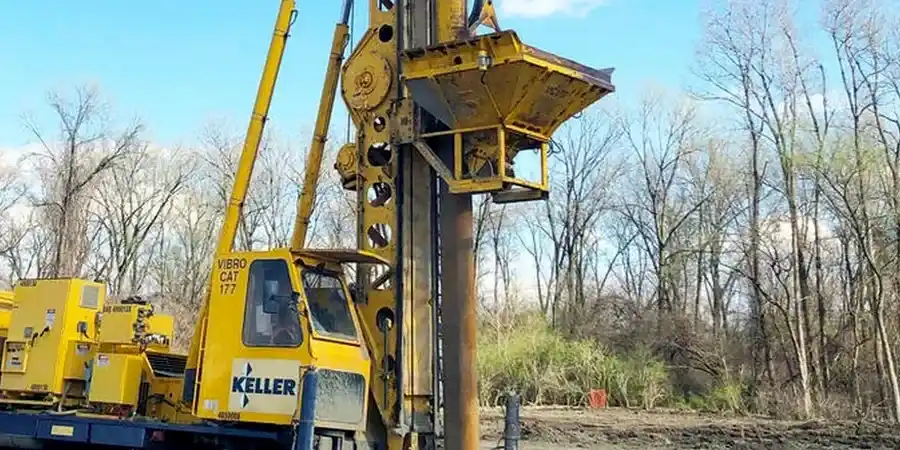
Regulatory compliance in Overland Park is governed primarily by the 2018 International Building Code (IBC) as adopted by the City of Overland Park, with amendments specific to local conditions outlined in Chapter 18 of the municipal code. Geotechnical investigations must conform to Johnson County's adopted standards, which reference ASTM D1586 for Standard Penetration Testing and ASTM D2487 for soil classification. The city requires thorough subsurface exploration reports for all commercial and multi-family developments, with ground improvement designs sealed by a professional engineer licensed in Kansas. For projects in FEMA-mapped flood hazard zones, additional requirements from the City's Stormwater Management Manual apply, and any improvement technique must demonstrate that it will not adversely alter drainage patterns or increase flood risk to adjacent properties. Adherence to these codes ensures that solutions like vibrocompaction are designed and executed to meet both safety and environmental standards.
The types of projects that routinely require ground improvement in Overland Park span the full spectrum of civil construction. Large-footprint commercial structures such as distribution warehouses and retail centers in the southern growth corridor often encounter thick deposits of compressible clay requiring deep foundation support or mass ground treatment. Multi-story office buildings and parking structures in the College Boulevard area may need stone columns to control differential settlement between heavily loaded columns and lightly loaded slabs. Infrastructure projects, including bridge approaches, retaining walls, and roadway embankments over soft alluvium, benefit from techniques that accelerate consolidation and increase shear strength. Even residential subdivisions on expansive clay sites increasingly incorporate ground improvement to mitigate foundation distress caused by seasonal moisture fluctuations. In each case, the selection of an appropriate method depends on a detailed geotechnical analysis of the specific soil profile, loading conditions, and performance criteria established by the structural engineer.
Available services
Common questions
What is ground improvement and when is it necessary in Overland Park?
Ground improvement refers to engineering techniques that modify soil properties to enhance bearing capacity, reduce settlement, or mitigate liquefaction. In Overland Park, it becomes necessary when native soils—such as expansive clays, loose alluvial sands, or soft silty deposits—cannot safely support proposed structural loads without treatment. A geotechnical investigation determines whether improvement is required based on site-specific conditions and building code requirements.
How do local soil conditions in Overland Park affect the choice of ground improvement methods?
Overland Park's subsurface typically includes high-plasticity residual clays prone to shrink-swell behavior and alluvial deposits with low bearing capacity. These conditions often favor stone columns for cohesive soil reinforcement or vibrocompaction for granular deposits. The presence of shallow bedrock in some areas may limit certain deep improvement techniques, making site-specific geotechnical evaluation essential for selecting the most effective and economical solution.
What building codes and standards regulate ground improvement in Overland Park?
Ground improvement in Overland Park must comply with the 2018 International Building Code as adopted locally, along with City of Overland Park Municipal Code Chapter 18. Geotechnical investigations follow ASTM standards for soil testing and classification. Designs must be sealed by a Kansas-licensed professional engineer, and projects within FEMA flood zones must also satisfy the City's Stormwater Management Manual requirements to ensure drainage is not adversely affected.
Can ground improvement eliminate the risk of foundation settlement entirely?
While ground improvement significantly reduces settlement risk, it cannot commit to absolute zero settlement. Properly designed stone columns or vibrocompaction can limit total and differential settlement to acceptable tolerances specified by structural engineers. Residual settlement is typically minor and accounted for in the foundation design. Long-term performance depends on accurate geotechnical characterization, quality construction, and adherence to design specifications.
Location and service area
We serve projects across Overland Park and surrounding areas.